Every drywall estimating guide says to deduct openings. Every experienced estimator deducts almost none of them. Both are right, and the difference is what happens to the material that comes out of the hole.
Why small openings are not a saving
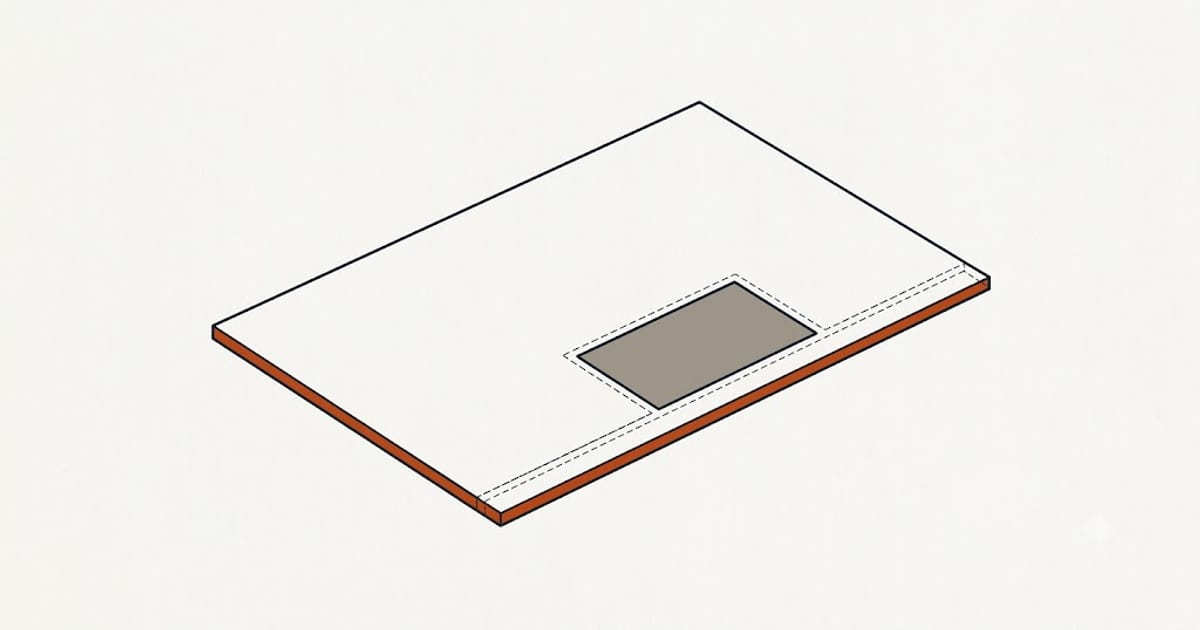
Drywall goes over an opening and gets cut out afterwards. That is not laziness — it is the correct method, because a joint landing on a door corner cracks, and running the sheet past the opening puts the joint elsewhere.
So a standard 3 ft × 6 ft 8 in door — 21 ft² — is boarded over and cut out. The 21 ft² that comes out is a piece 3 ft wide with a corner missing, and there is very rarely somewhere to use it.
The board was bought. It was hung. It went in the skip. Deducting it from the estimate means buying one less sheet than the job consumes.
The threshold
The convention across the trade:
- Under 32 ft² — do not deduct. Doors, windows, pass-throughs. That covers essentially every opening in a house.
- 32 ft² and over — deduct half. Large picture windows, wide cased openings.
- Over 64 ft², or a full wall opening — deduct fully. Garage doors, sliding walls, open stairwells.
32 ft² is roughly a 4 × 8 sheet. Below that the offcut is fragmentary; above it there is genuinely a usable piece.
What you gain instead of board
Openings do reduce finishing work slightly, and they add other work that more than cancels it.
Corner bead. Every opening needs bead on its outside corners. A door in a 2×4 wall with returns has roughly 16 linear feet of bead; a window has around 14. At $2.40 per 8 ft length plus the compound to fill it, an opening costs $8–12 more in bead than the wall it replaced.
Returns and reveals. Where a window has drywall returns rather than wood jamb extensions, each return is a narrow strip of board that has to be cut, fitted, taped on both edges and finished. Four returns around a window is more finishing labour per square foot than any flat wall in the house.
Time. Cutting an opening out cleanly, from the back, with a rotary tool or a saw, is a few minutes per opening.
Net: openings make a room cost more per square foot of floor, not less.
A worked take-off
A 12 × 16 room, 8 ft ceilings, one door, two windows, one closet opening.
Gross wall area: perimeter 56 ft × 8 ft = 448 ft² Ceiling: 12 × 16 = 192 ft² Gross total: 640 ft²
Openings: door 21 ft², windows 15 ft² each, closet opening 26 ft². All under 32 ft², so deduct none.
Sheets at 4 × 12 (48 ft²): 640 ÷ 48 = 13.3 → 14 sheets.
Add 10% waste for offcuts and mis-cuts and it is 15 sheets. Most estimators would order 15 and be right.
Had all 77 ft² of openings been deducted, the calculation gives 563 ft², 11.7 sheets, and an order of 12 — three sheets short, and the shortfall is discovered on the last wall.
Ancillaries scale with the wall, not the deduction
| Line | Basis | This room |
|---|---|---|
| Compound | 0.5–0.7 gal / 100 ft² | 3.5–4.5 gal |
| Tape | ~370 ft / 1,000 ft² | 240 ft |
| Screws | ~1 lb / 300 ft² | 2.5 lb |
| Corner bead | Per opening + outside corners | 5–6 lengths |
Compound in particular tracks the number of joints, not the area — a room chopped up by openings has more linear feet of joint per square foot of board and can run 50% over the rate above. How much compound per sheet covers that properly.
Where contractors do deduct
Two cases.
Bidding. A contractor pricing by the square foot of wall may deduct openings to stay competitive, then price the bead and returns as separate line items. The total is similar; the presentation differs. It is worth asking which convention a quote uses before comparing two of them.
Material-only orders on large commercial jobs, where offcuts get used across a big floor plate. That does not apply to a house.
The rule to build into an order
Board area = wall area + ceiling area, deduct nothing under 32 ft², add 10%.
Then check the number against the room-size table, and buy one extra sheet regardless. A sheet is $17.50; a second trip is an afternoon.