Drywall is dense. That is not incidental — the mass is what gives it fire resistance and acoustic performance — but it decides the logistics of every job before anything else does.
Weight by sheet
Standard gypsum board, at about 1.6 lb per square foot per 1/2 inch of thickness.
| Thickness | 4 × 8 | 4 × 10 | 4 × 12 | 4 × 16 |
|---|---|---|---|---|
| 1/4 in | 38 lb | 47 lb | 57 lb | — |
| 3/8 in | 45 lb | 56 lb | 67 lb | — |
| 1/2 in | 52 lb | 64 lb | 77 lb | 103 lb |
| 1/2 in lightweight | 39 lb | 49 lb | 58 lb | 78 lb |
| 5/8 in Type X | 70 lb | 88 lb | 105 lb | 140 lb |
Two figures matter most in practice. A 4 × 12 sheet of 1/2 in at 77 lb is a two-person carry for most people. A 4 × 12 of 5/8 in Type X at 105 lb is a two-person carry for everyone, and a lift on a ceiling.
Lightweight board
Lightweight 1/2 in board runs about 25% lighter — 58 lb for a 4 × 12 against 77 lb. It is a genuinely different formulation with a lower-density core, not a marketing name.
It handles noticeably better, costs $1–2 more per sheet, and has one trade-off worth knowing: it is slightly softer and dents a little more easily. On walls it is fine. In a garage or a hallway, standard or abuse-resistant board is the better choice.
There is no lightweight Type X — the fire rating depends on the core density.
A room's worth
For a 12 × 16 room, 640 ft² of board, 14 sheets of 4 × 12:
| Board | Total |
|---|---|
| 1/2 in standard | 1,078 lb |
| 1/2 in lightweight | 812 lb |
| 5/8 in Type X | 1,470 lb |
Over half a ton for a single small room, and three quarters of a ton in Type X.
A whole house of 2,400 ft² takes roughly 5,500 ft² of board — about 8,800 lb, or four and a half tons.
What that means for delivery
Pickup trucks. A half-ton pickup has a payload of 1,300–1,800 lb — around 17 sheets of 1/2 in 4×8, or 11 sheets of 4×12. One room. People routinely load twice that and it is well past the axle rating.
Boom delivery. Most yards will place a stack on a second floor or through a window opening for $75–200. Against carrying 1,078 lb up a staircase by hand, it is not a close call.
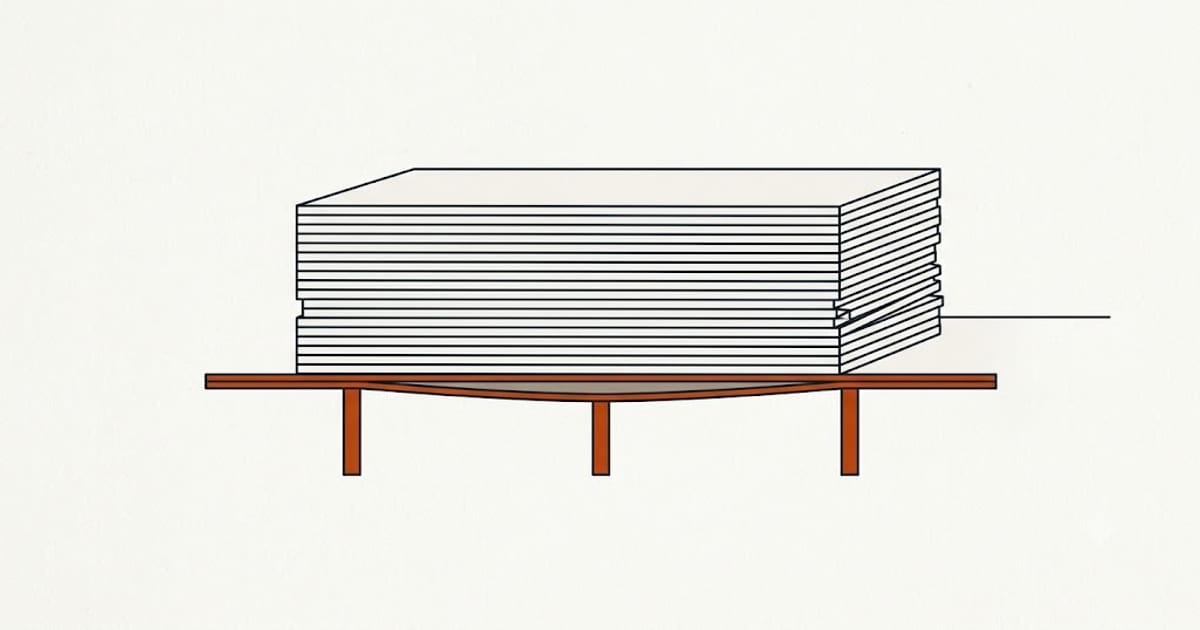
Floor loading. This is the one that gets missed. A stack of 30 sheets of 4 × 12 1/2 in is 2,310 lb standing on roughly 32 ft² — about 72 psf, against a residential floor's 40 psf design live load.
Stacking board flat in the middle of a joist span, especially on a second floor or over a basement, is a real overload. Stack over a bearing wall or against a wall, split large deliveries into several piles, and never stack in the middle of a room.
Stack flat, not on edge. Board leaned on edge against a wall bows within a day, and a bowed sheet is difficult to hang tight against framing.
Which sheet size
Longer sheets are heavier per sheet and produce fewer joints, and joints are the labour. A 12 ft wall boarded with 4 × 12 sheets has no butt joints at all; the same wall in 4 × 8 has one every 8 ft, and butt joints are the hardest joints to finish invisibly because there is no factory taper to work into.
That trade-off — fewer joints against heavier lifting and harder handling in tight spaces — is worked through in 8 ft against 12 ft sheets.
Practical handling
A sheet lifter — a foot-operated lever that raises a sheet the last inch off the floor — costs $12 and turns a two-person wall lift into a one-person job.
A panel carry handle does the same for moving sheets. Both are the sort of tool that seems unnecessary until sheet six.
A drywall lift for ceilings is $35–55 a day and it is the single item most worth renting. Holding a 105 lb sheet overhead while driving screws is how sheets get dropped, and a dropped sheet on a ceiling breaks along the fold.
Disposal weighs the same
Tear-out weighs what installation weighed, plus whatever moisture and paint it has picked up. A 12 × 16 room's ceiling and walls coming out is over half a ton going into a skip, and skips are priced by weight above a threshold.
That figure belongs in the repair-or-replace decision, because the haul-away line on a full ceiling replacement is not trivial.