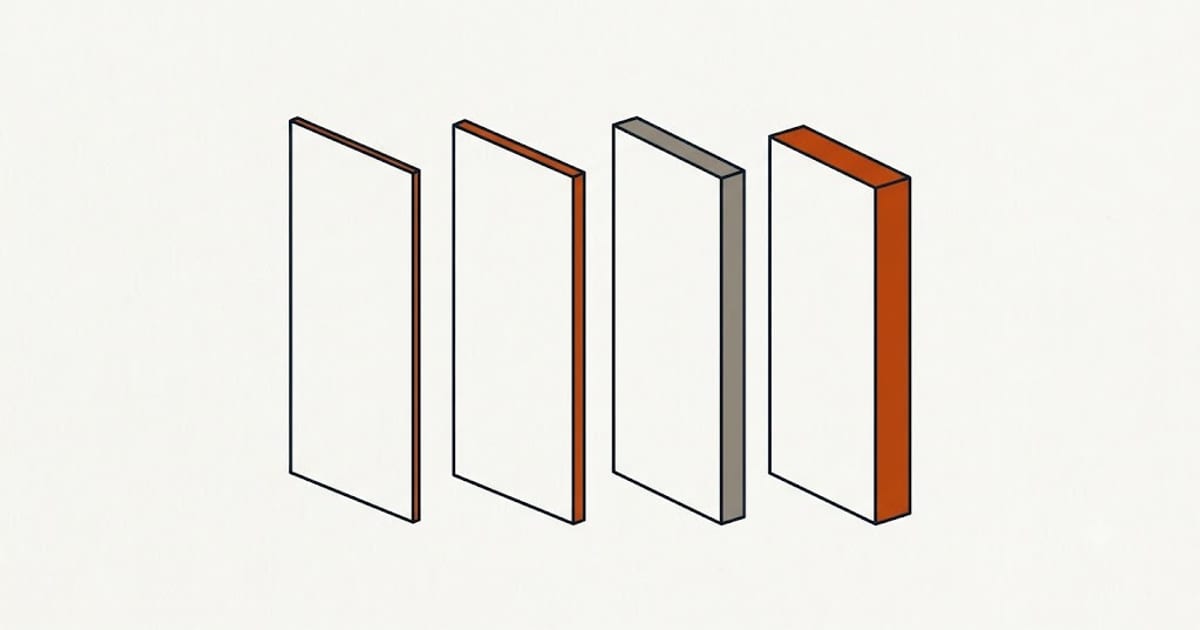
Drywall comes in four thicknesses and the choice is mostly made for you — by framing spacing, by fire rating, and by whether the surface is a wall or a ceiling.
The four
| Thickness | Weight, 4×8 | Where it belongs |
|---|---|---|
| 1/4 in | 38 lb | Curves, and overboarding an existing surface |
| 3/8 in | 45 lb | Overboarding, repairs matching old 3/8 |
| 1/2 in | 52 lb | Standard walls, and ceilings at 16 in o.c. |
| 5/8 in | 70 lb | Fire-rated assemblies, ceilings at 24 in o.c., sound |
1/2 inch: the default, and its one limit
Half-inch board is the standard for residential walls on studs at 16 or 24 in on centre, and for ceilings on framing at 16 in on centre.
The limit that catches people: 1/2 in board sags on ceiling framing at 24 in on centre. Trusses at 24 in are extremely common in modern construction, and half-inch board on them will develop a visible waviness between framing members over a few years, worse if there is blown insulation above it.
Two correct answers: 5/8 in board, or a product sold as 1/2 in ceiling board — a sag-resistant formulation specifically rated for 24 in spacing. Ordinary 1/2 in is not.
5/8 inch: fire, sound and ceilings
Type X 5/8 in is the fire-rated product, and it is required rather than recommended:
- Garage walls and ceilings adjoining living space
- Between attached dwelling units
- Furnace and utility room enclosures in many jurisdictions
- Any assembly with a listed fire rating
Type X gets its rating from glass fibre in the core that holds the board together as the gypsum's chemically bound water is driven off. Substituting standard 5/8 in for Type X in a rated assembly is a code violation that an inspector will catch, because the board is stamped.
5/8 in is also the better choice on any ceiling, rated or not — it sags less and it is quieter. The cost difference is roughly $3–4 per sheet, which on a room's ceiling is under $30.
Sound: 5/8 in adds roughly 2 STC over 1/2 in. Real, but small compared with what decoupling or a resilient channel does. Doubling up two layers of 5/8 with the joints offset is the effective drywall-only approach.
3/8 inch: overboarding
Its main modern use is going over an existing surface — old plaster, or panelling — where adding 1/2 in would foul the trim and door casings.
It is also what many pre-1970 houses were built with, so a repair into an old wall may need it to keep the surfaces flush.
It is not a wall board on its own. On studs at 16 in it is too flexible, and it dents.
1/4 inch: curves and skins
Two jobs.
Curves. Quarter-inch board bends to a radius of about 5 ft dry, and much tighter wetted. Two layers of 1/4 in laminated together on a curve is the standard method and gives a 1/2 in finished thickness with the strength back.
Skinning. A fresh face over a wall that is sound but ruined — wallpaper that will not come off, damaged plaster, textured surfaces nobody wants to skim. It adds a quarter inch and gives a new surface.
Never on its own over open framing. It has no rigidity and will telegraph every stud.
The specialty boards
Worth knowing because they are frequently specified and occasionally over-specified.
Moisture-resistant (green board). For humid rooms — bathroom walls away from direct wetting, laundries. It is not a tile backer and it is not for a shower surround. Behind tile in a wet area, use cement board or a foam backer board.
Mould-resistant (purple). Paperless or treated facing. Genuinely better than green board and now often the same price. Reasonable default in bathrooms and basements.
Abuse-resistant. Denser core, tougher facing. Corridors, garages, rentals, anywhere with traffic.
Soundproofing panels. Constrained-layer damping between two gypsum layers. Effective and expensive — several times standard board.
Weight decides how you handle it
The thickness decision has a practical consequence that shows up on install day: a 4 × 12 sheet of 5/8 in weighs 105 lb, against 77 lb for 1/2 in. That is a two-person sheet on a wall and a lift on a ceiling.
The full table, and why sheet size matters as much as thickness for the weight, is in what a sheet of drywall weighs. And the choice between 8 ft and 12 ft sheets interacts with it — longer sheets mean fewer joints but heavier lifts.
What thickness does not fix
Framing that is not flat. A stud crowned 1/4 in proud of its neighbours shows under raking light through any thickness of board, and it takes ten seconds to plane before boarding and a skim coat afterwards.