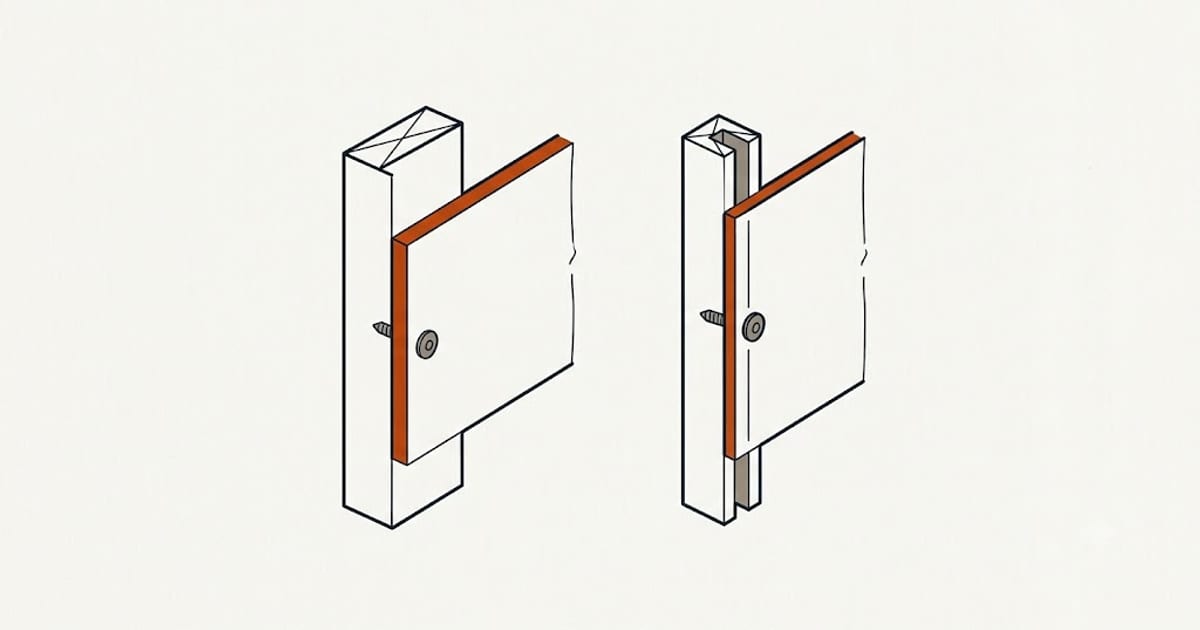
A screw pop is a small circular bump, sometimes with a crack around it, appearing in a wall or ceiling months after the paint dried. There is a screw at the centre of it and the natural conclusion is that the screw failed.
It did not. The wood behind it moved.
The mechanism
Framing lumber is delivered at a moisture content of 15–19% — kiln-dried construction lumber is graded to 19% or less and often arrives wetter. Inside a heated, occupied house it equilibrates to 7–9%.
Wood shrinks as it dries, and it shrinks across the grain far more than along it. A nominal 2×4 loses roughly 1/8 inch across its 3.5 in width going from 19% to 8%, and a 2×10 joist loses proportionally more across its depth.
The drywall does not shrink. It is fastened to a stud that is getting narrower, so the stud's face retreats from the back of the board. The board stays put — it is held by its neighbours and by its own stiffness — and the screw, which is anchored in the wood, travels backward with the stud until its head pushes forward through the compound covering it.
Hence: the head appears, the compound over it cracks and lifts, and a small dome forms.
Why they arrive when they do
In the first heating season. Drying accelerates sharply when a house is heated and the indoor humidity drops. Pops appear from roughly two to eight months after occupancy and largely stop after the first winter, because by then the framing has reached equilibrium.
On exterior walls more than interior ones. Larger temperature and humidity gradient, and often more lumber in the assembly.
On ceilings more than walls. Joists are deeper, so they shrink more in absolute terms, and gravity adds load.
In clusters. All the screws on one stud pop together, because it is that stud drying.
A house getting pops in year five is telling a different story — usually a moisture problem or a structural movement — and is worth investigating rather than filling.
The repair that holds
The instinct is to fill the dome and paint. That fails, because the screw is still there and still attached to a stud that may still be moving.
Correct method:
- Drive a new screw 1.5 to 2 in away from the popped one, into the same framing member, pulling the board tight against the stud. Set it just below the surface without breaking the face paper.
- Then deal with the original. Either drive it deeper — below the surface, if it will still bite — or back it out completely and remove it. Leaving it proud and covering it guarantees a repeat.
- Fill both with setting-type compound for the first coat, then two thin coats of lightweight, each wider than the last. Feather 6–8 in.
- Prime the patch before painting, or the repair will read as a different sheen even when it is perfectly flat.
- Repaint corner to corner. Spot-painting a wall shows the patch as surely as the pop did.
What prevents them
Let the lumber dry. Boarding a house as soon as it is dried in guarantees pops. Where the schedule allows, heat and ventilate the framing for a few weeks first — this is the single most effective measure and the one most often impossible.
Fewer screws, plus adhesive. Construction adhesive on the face of each stud with screws only near the panel edges is a standard commercial approach. Adhesive is flexible and shears slightly with the wood's movement instead of transmitting it, and there are far fewer fastener heads to appear.
Correct depth. A screw driven so hard it breaks the face paper holds nothing but the gypsum core, and it works loose readily. A depth-setting nose on the gun costs $8. How many screws per sheet and at what spacing covers the pattern; the depth is what most DIY jobs get wrong.
Screws, not nails. Nails withdraw under the same movement and do so more readily, which is why nail pops were epidemic before screws became standard.
Engineered framing. I-joists and LVL are manufactured at low moisture content and barely move. Ceilings framed with them almost never pop.
When it is not a pop
A line of cracks along a joint rather than a circular dome is a taping or a movement problem, not a fastener one — often mesh tape bedded in all-purpose compound over a butt joint, which is the wrong pairing.
Sagging between framing members, with or without pops, on a ceiling is usually 1/2 in board on 24 in centres — under-specified board rather than fastener failure, and it does not respond to re-screwing. Thickness by application covers the requirement.
Cracks radiating from window and door corners are framing movement or settlement. Filling them is cosmetic and they come back on the same schedule every year.
Timing the repair
Wait out the first heating season before doing a comprehensive pass. Repairing pops in November and finding twenty more in February is normal, and doing the whole wall once in spring is one repaint instead of two.