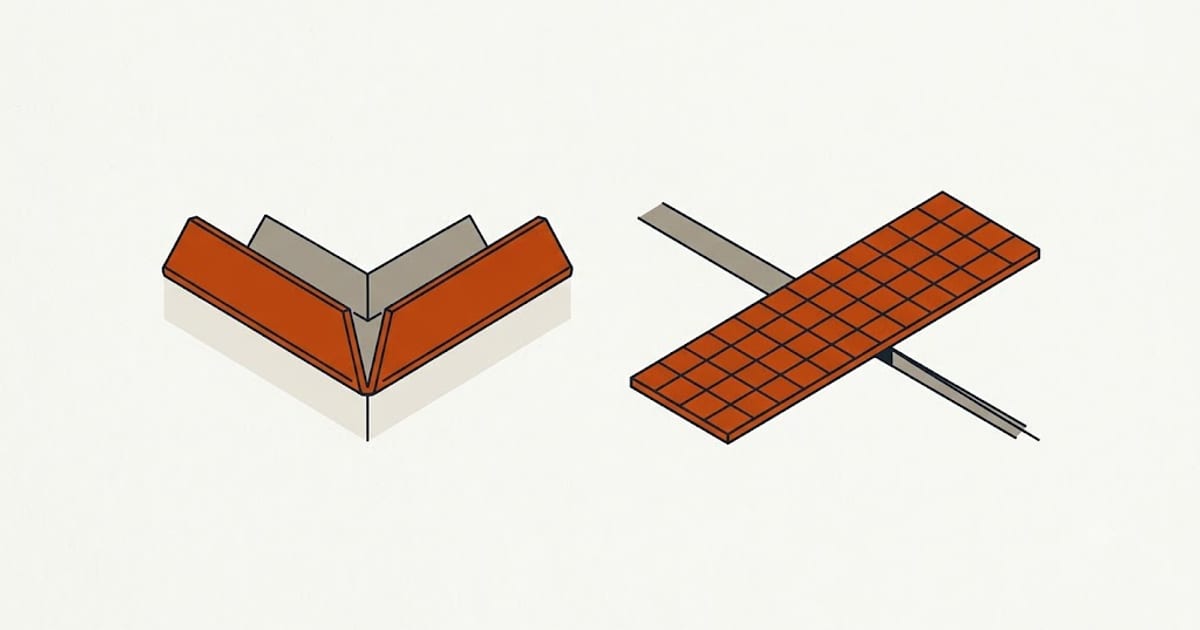
Both tapes work. The rule that decides which is not about the tape — it is about what goes over it.
Mesh tape requires setting-type compound. Paper tape works with anything.
Mesh under ready-mix is the most common cause of cracked joints in DIY drywall, and it looks perfect for about six months.
Why
Paper tape is a solid membrane. It is embedded in a bed of compound and adds real tensile strength across the joint — the paper itself resists the movement.
Mesh tape is an open grid with adhesive backing. It has no strength on its own; the strength comes from compound filling the openings and hardening into a continuous layer. Ready-mix compound is comparatively soft and shrinks as it dries, so it never forms that continuous layer, and the joint flexes.
Setting-type compound ("hot mud" — 20, 45, 90 minute) hardens chemically, is much harder, and shrinks very little. It fills the mesh and locks it.
Inside corners: paper only
Mesh cannot be creased. It will not sit tight in an inside corner, it bridges the angle, and the resulting hollow cracks the first time the framing moves.
Paper tape has a factory crease down the middle. Fold it, bed it, and it stays in the corner.
There is no version of this where mesh in an inside corner is acceptable, and it is the most common place beginners try to use it because it is stickier and easier to place.
Where mesh genuinely helps
- Flat butt joints — the self-adhesive backing holds it while you work, and there is no bedding coat to get wrong
- Patches and repairs — a mesh patch over a hole is quick, strong, and needs no bedding
- Over-mesh on a re-taped crack — with setting compound
For a first-timer taping flat joints with setting compound, mesh removes the hardest skill on the job: bedding paper tape without trapping air or squeezing out too much compound.
Where paper is the only answer
- Every inside corner
- Every joint where ready-mix is the compound
- Anywhere maximum strength matters — over a butt joint, or on a ceiling
The mistake that reveals itself late
Paper tape bedded in too little compound has nothing to bond to and blisters — a bubble along the joint that shows up when the second coat dries.
The fix is to cut out the blistered section, re-bed it, and re-coat. There is no fix that does not involve cutting.
Test as you go: run the knife along the freshly bedded tape and you should see a small even squeeze-out along both edges. No squeeze-out means not enough compound underneath.
Corner bead is a third thing
Outside corners take corner bead, not tape — metal, vinyl or paper-faced metal.
Paper-faced metal bead is the most forgiving of the three: it goes on with compound like tape, holds a straight edge like metal, and does not dent like vinyl. It is what most professionals use, and it is worth the small premium on any corner people will brush past.
Quantities
Roughly 380 linear feet of tape per 1,000 ft² of board. A 500 ft roll of paper covers a typical room with spare.
Corner bead is measured in linear feet of actual outside corners, and it does not scale with area — a room with a bulkhead and two returns needs far more than its square footage suggests. Count them.
Everything else scales off the board area — the sheet count and the compound the finish level requires.
Fibreglass mesh for repairs is a different product
The self-adhesive mesh sold in small rolls for patching is the same material as taping mesh, and the same rule applies: it wants setting-type compound over it.
For a hole larger than about 4 inches, mesh alone is not enough regardless of compound. That needs a backing — a piece of board screwed to a strip of plywood behind the opening — and then tape over the seams like any joint.
Cracks that come back
A joint that cracks once and is re-taped in the same way cracks again, because the tape was never the problem. Recurring cracks come from movement:
- A truss uplift crack at a wall-to-ceiling junction, appearing every winter and closing every summer — this needs a floating corner or crown moulding, not tape
- A crack over a door or window running diagonally — the framing is moving, and the fix is structural
- Long straight cracks along a butt joint — often mesh over ready-mix, and re-taping with paper solves it permanently
Diagnose which one you have before re-taping, or you will do the same repair every year. And on a wall being re-finished afterwards, decide the finish level before the first coat rather than after.