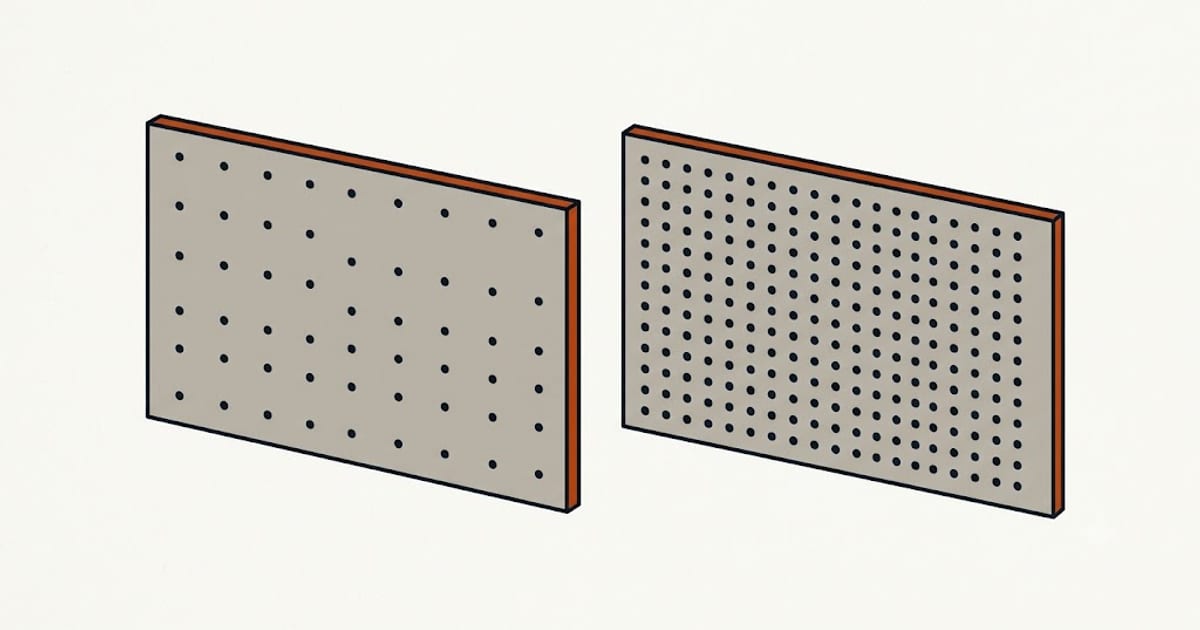
| Sheet | Framing | Field spacing | Screws |
|---|---|---|---|
| 4 × 8 wall | 16″ o.c. | 16″ | ~32 |
| 4 × 8 ceiling | 16″ o.c. | 12″ | ~40 |
| 4 × 12 wall | 16″ o.c. | 16″ | ~48 |
| 4 × 12 ceiling | 16″ o.c. | 12″ | ~60 |
| 4 × 8 wall | 24″ o.c. | 12″ | ~28 |
Add 10% for misses, and for the ones that need backing out and re-driving.
A pound of 1¼″ drywall screws is roughly 300. A 5 lb box is about 1,500 — enough for around 45 wall sheets. A 25 lb bucket is about 7,500.
For a 12 × 14 room at 19 sheets, one 5 lb box covers it with margin.
Length by board thickness
The screw must penetrate the framing by at least ⅝ inch into wood.
| Board | Screw length |
|---|---|
| ½″ into wood | 1¼″ |
| ⅝″ into wood | 1⅝″ |
| Double ½″ layer | 2″ |
| ½″ into 25-gauge steel stud | 1″ fine-thread |
| ⅝″ into steel stud | 1¼″ fine-thread |
Coarse thread for wood, fine thread for steel. A coarse-thread screw in a steel stud spins without gripping; a fine-thread screw in wood strips the hole. Both failures look identical from the front and both are found later.
Perimeter spacing is tighter
8 inches around the edges of every board, on both walls and ceilings, and at least ⅜ inch in from the edge.
Closer than ⅜ inch and the screw blows out the edge of the board, which leaves nothing holding that corner and a crumbling edge to tape over.
Depth is what causes pops
The screw should dimple the paper without tearing it — a shallow depression the compound fills flush.
- Overdriven, through the paper: the board hangs on friction and the screw will pop
- Underdriven, standing proud: it holds the next course off the framing and telegraphs through the finish
Set the clutch on a scrap piece at the start of each session. Board warms and softens during the day, so a setting that was right in the morning drives too deep by afternoon.
A dimpler bit (a depth-stop attachment) removes the judgement entirely and costs a few dollars. On a whole-house job it is the difference between a hundred pops and none.
Two rules that are not about count
Do not screw into the corner itself. Inside corners get no fasteners within about 8 inches of the corner on one of the two surfaces — the "floating corner" method — so seasonal framing movement is absorbed by the board flexing rather than by the tape cracking.
Do not mix nails and screws. Nails work loose over years of framing movement; screws do not. A wall with both develops pops only in the nailed areas, which is a strange-looking defect and a full re-finish to fix.
Adhesive halves the fastener count
Construction adhesive on the framing before hanging, in a bead, lets you reduce field screws to roughly 24 inches apart while keeping the perimeter tight. It also removes almost all pops, because the board is bonded rather than clamped.
It is standard practice on ceilings for exactly that reason, and it is worth doing anywhere the framing is new and still drying — which is where pops come from in the first place.
Buy against the sheet count
Screws, tape, compound and corner bead all scale off the same board area. Settle the sheet count first and the rest follows from it — including how much compound the finish level demands.