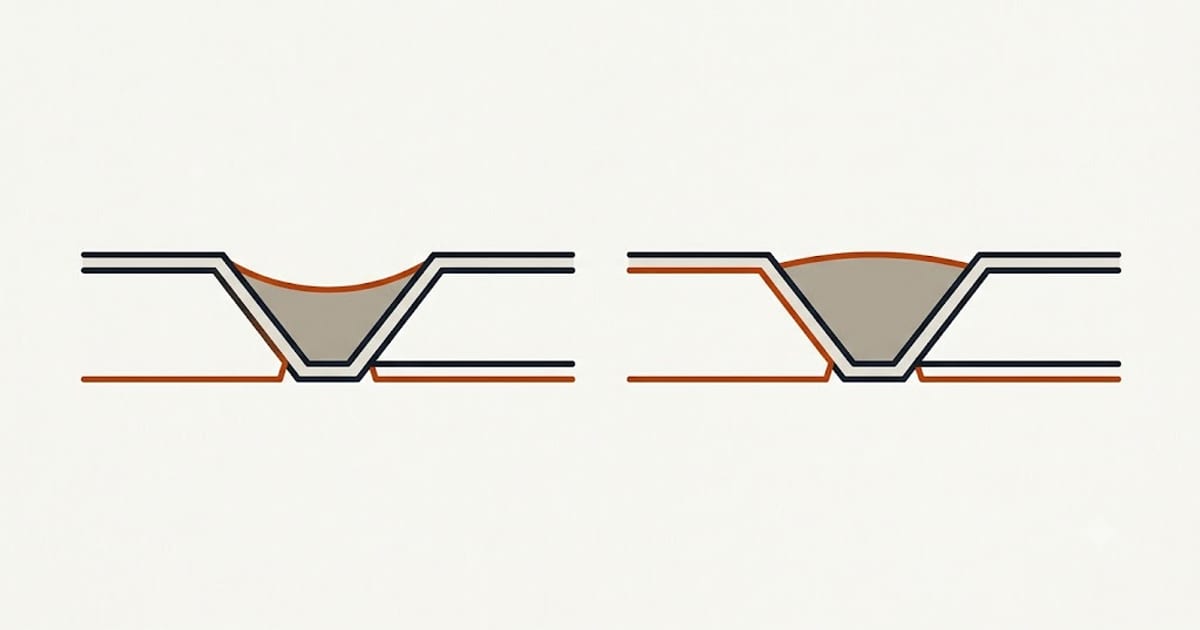
These are the two buckets on the shelf, they cost within a dollar of each other, and most people buy whichever is nearer. They behave differently enough that one coat of a three-coat job should be the other one.
The difference in the bucket
All-purpose is a vinyl-binder compound with limestone filler. Dense — about 12.5 lb per gallon. It is the general-purpose product the trade grew up on.
Lightweight all-purpose replaces some of the limestone with expanded perlite or hollow glass microspheres. About 9 lb per gallon, roughly a third lighter for the same volume.
That density change drives everything else.
Head to head
| All-purpose | Lightweight | |
|---|---|---|
| Weight, 4.5 gal | 56 lb | 38 lb |
| Bond strength | Higher | Lower |
| Shrinkage | Higher | Lower |
| Sanding effort | Harder | Much easier |
| Drying time | 24 hr+ | 16–24 hr |
| Coverage per bucket | ~750 ft² | ~850 ft² |
| Crack resistance in fills | Better | Worse |
| Price, 4.5 gal | $17–20 | $18–22 |
Where lightweight wins, and it is most places
Sanding. This is the reason it took over. The soft filler abrades easily, so feathering an edge takes a fraction of the effort and produces less dust. On a hand-finished job, sanding is the longest and least pleasant operation, and lightweight roughly halves it.
Shrinkage. Less filler suspended in water means less volume lost on drying. On a fill coat over tape, or over a screw dimple, that is the difference between two coats and three.
Weight. A 4.5 gallon bucket at 38 lb against 56 lb matters when it is being carried up stairs and lifted onto a bench forty times.
Drying. Somewhat faster, which on a DIY schedule where each coat costs a day is worth something real.
Where all-purpose wins, and it matters
The bedding coat. The first coat, under the tape, is a structural bond. It has to grip paper tape and hold the joint together against the movement of the framing behind it.
All-purpose bonds better. On a butt joint — where two factory-cut ends meet with no taper — this is not a subtlety. Butt joints are under more stress and have no recess to hold compound depth, and a butt joint bedded in lightweight is a common source of a hairline crack appearing after the second heating season.
Filling and repairs. Deep fills, gouges, and any hole being patched. All-purpose has more body and cracks less in thickness.
Setting corner bead. More grab, less movement while it sets.
The three-coat pattern
The standard professional sequence, and it uses two products:
| Coat | Product | Why |
|---|---|---|
| Bed the tape | All-purpose, or setting-type | Bond strength |
| Fill over the tape | Lightweight | Low shrink, easy feather |
| Skim / finish | Lightweight, or topping | Sands to nothing |
Buying one bucket of all-purpose and one of lightweight for a room costs about $40 total and is the correct answer. Buying two of lightweight saves nothing and puts the weaker product where the strength is needed.
Setting-type is a different animal
"Hot mud" — sold as a powder with a number on the bag that is its working time in minutes. It cures chemically rather than drying, so it works in a cold damp basement where premixed compound sits wet for two days, and it barely shrinks.
It is also unforgiving: 20-minute mud is unusable at minute 25, it does not clean off tools easily, and it is very difficult to sand.
Use it for the bed coat when the schedule is tight, and for deep fills. Do not use it for the final coat unless you have done it before — the finish levels all assume a sandable final surface.
Note also: setting-type is what mesh tape requires. Mesh in all-purpose over a butt joint is the standard recipe for a crack, and the tape comparison explains why.
Topping compound
The third product, and worth mentioning because people mistake it for lightweight.
Topping has very low bond strength and superb sanding. Final coat only. Bed tape in topping and the tape will let go — not immediately, which is the problem, but at the first seasonal movement.
How much to buy
Roughly 0.5–0.7 gallons per 100 ft² of board for a level 4 finish over three coats. A 4.5 gallon bucket covers 700–900 ft², or 22–28 sheets.
That figure tracks the number of joints, not the area, so a room broken up by openings and short walls can run 50% over. Compound per sheet works it through, and the tape quantity scales the same way.
The one habit that saves a coat
Mix it. Compound settles in the bucket and the top is thinner than the bottom. Two minutes with a paddle on a drill gives a consistent product, and consistency is most of what makes a coat feather rather than drag.