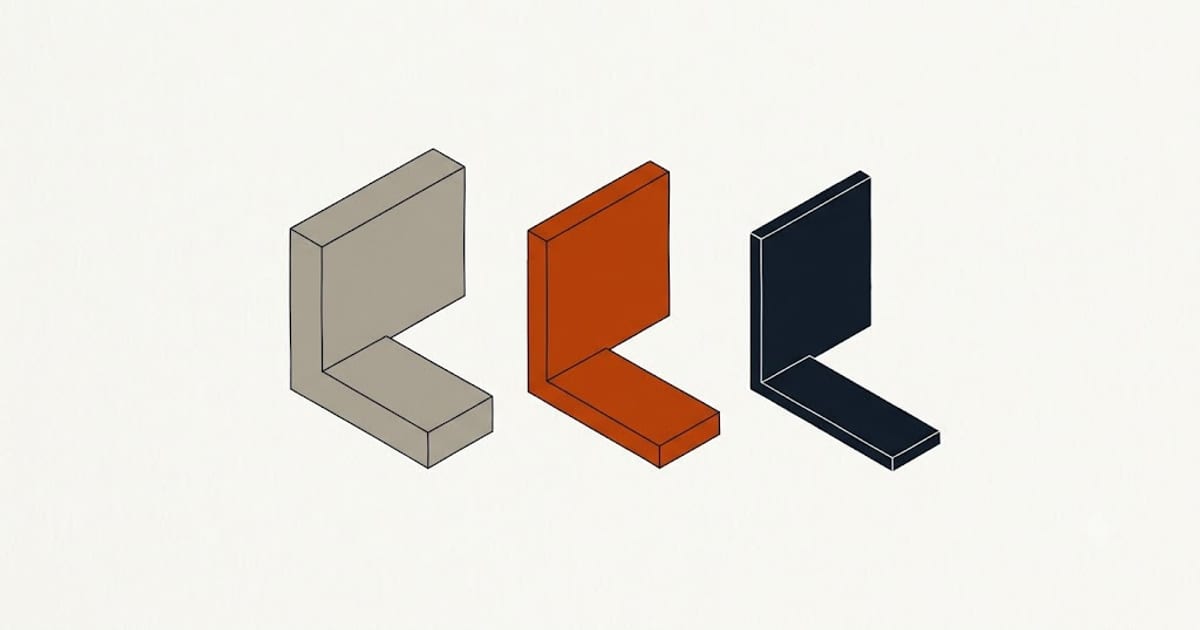
Every outside corner in a drywalled room has a bead behind the compound. It gives the corner a straight edge to finish to, and it takes the impact of everything that hits it.
Three types are in common use and they fail in three different ways.
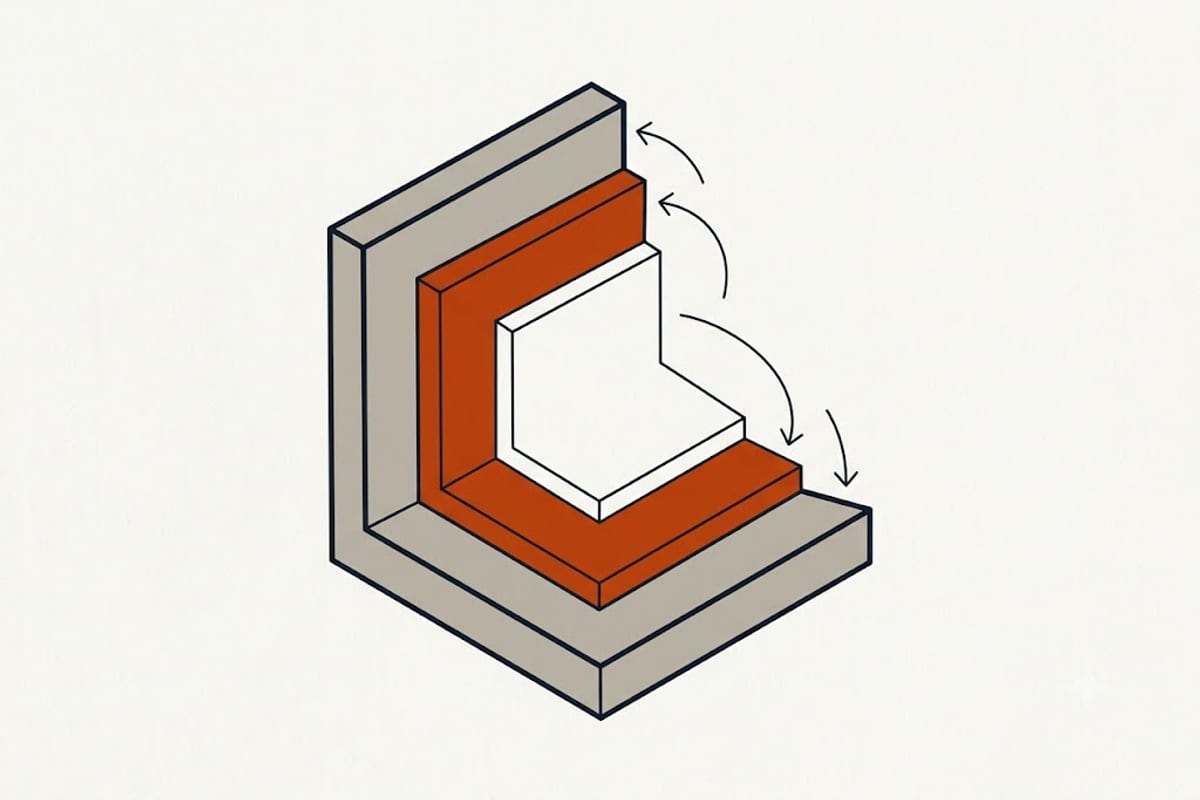
Metal bead — stiff, and it dents
Galvanised steel, nailed or screwed through the drywall into the framing, or clinched with a bead crimper.
Strong against ordinary knocks, and it holds a very straight line even where the framing is not.
It dents. A hard impact deforms the metal permanently, and because the compound over it is rigid, the deformation cracks the finish. Repairing a dented metal bead means cutting the bead out.
It can rust. In a bathroom or an unconditioned space, moisture reaches the steel through the compound and the rust bleeds through the paint as a brown line. Once it starts it comes back through every repaint.
Fasteners are also a weakness: nails work loose as framing dries, and the corner develops a line of small cracks at each one.
Paper-faced bead — the flattest finish
A metal or composite core with paper flanges. It is bedded in joint compound rather than fastened, exactly like tape.
Bonds across its whole surface rather than at fastener points, so it does not develop nail-line cracking.
Finishes flattest, because the paper flange feathers like tape instead of stepping like a metal flange. On a wall that will be painted in a sheen, this is a visible difference.
Requires clean work. It must be fully bedded with no dry spots or the paper blisters later, and the corner must be reasonably straight to begin with — the bead follows the framing rather than correcting it.
This is the standard for quality residential work and it is what most finishers prefer.
Vinyl bead — no rust, no dents
Will not rust, which makes it the right choice in bathrooms, basements, garages and any exterior soffit.
Will not dent — it flexes and returns.
It moves. Vinyl expands and contracts with temperature more than the compound around it, and in an unheated space that movement can crack the finish along the corner. It is a poor choice in a garage that swings from freezing to hot.
Vinyl is usually applied with spray adhesive and staples, or as a paper-faced vinyl hybrid, which is the best of both for wet areas.
Bullnose and other profiles
Rounded bullnose bead softens the corner and is far more forgiving of impact, because there is no sharp arris to chip. It needs matching transition pieces where a bullnose corner meets a square one, and those pieces have to be ordered with the bead — improvising them is visible.
Off-angle bead exists for corners that are not 90 degrees, and using square bead on an off-angle corner is a permanent crack waiting to happen.
Why corners crack
In rough order of frequency:
Fastener movement on metal bead, as framing dries and shrinks.
Insufficient compound over the bead. The finish needs enough build to have some thickness at the edge of the flange; a thin coat cracks along that line.
Framing movement, particularly at a corner formed by two different framing members that move independently.
Thermal movement on vinyl in an unconditioned space.
Impact, which is the honest one.
Repairing rather than replacing
A cracked corner with a sound bead behind it is a repair: scrape the loose compound back to the bead, re-tape with mesh or paper if the crack runs into the flat, and refinish in three coats.
A dented bead has to come out. Cut along both flanges, remove the section, fit a new piece, and finish it. Filling over a dent is the repair that fails again in the same place, because the deformed metal is still there under the compound.