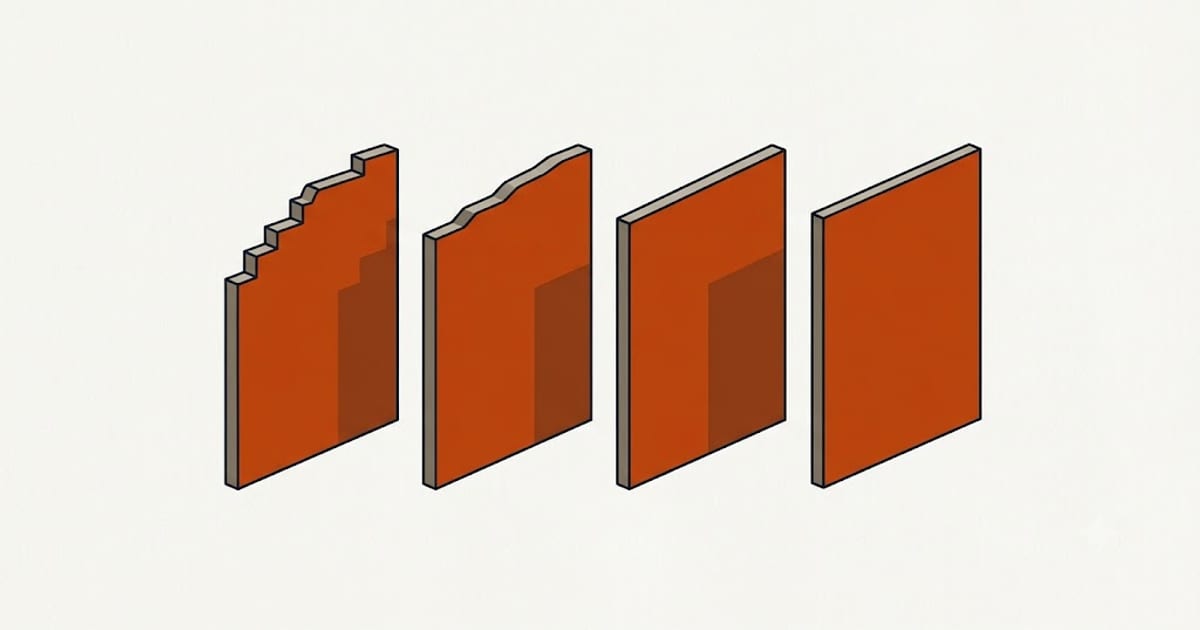
Finish levels are a published specification — GA-214, from the Gypsum Association — not a matter of taste. Naming one on a quote is how two contractors get compared on the same job.
| Level | What it is | Where it belongs |
|---|---|---|
| 0 | Board hung, nothing done | Temporary construction |
| 1 | Tape set in compound, no finishing | Above ceilings, inside plenums |
| 2 | Tape plus one coat over fasteners | Under tile, in garages |
| 3 | Two coats, no skim | Under heavy texture only |
| 4 | Three coats, feathered | The standard. Flat and eggshell paint, light texture |
| 5 | Three coats plus a full skim | Gloss paint, and any wall with raking light |
Level 4 is the standard, and its limitation is specific
Three coats over joints and fasteners, feathered out and sanded. Under flat or eggshell paint on a normally lit wall it is invisible, and it is what "finished drywall" means unless a quote says otherwise.
Its weakness is a real, physical one: the paper face of the board and the dried joint compound absorb paint differently and reflect light differently. In diffuse light nobody sees it. In light that runs along the wall, every joint appears as a faint band.
The test that decides Level 5
Stand at one end of the wall and look along it, not at it.
If a window, a door, a skylight or a recessed light throws light along the surface at a shallow angle, that wall will show its joints at Level 4. That is the condition — not the room, not the budget, not the paint colour.
The usual candidates:
- A long hallway with a window at one end
- A stairwell lit from above
- Any wall with recessed lights washing down it
- The wall opposite large windows in a room with dark floors
What Level 5 actually is
A thin skim coat of compound over the entire surface, not just the joints. It equalises absorption and texture so the whole wall behaves as one material.
The cost is 40–60% more than Level 4, and most of the increase is sanding — the skim covers every square foot, so every square foot gets sanded. The cost lines are broken out here.
A tinted primer-sealer designed for drywall gets partway there for far less, and is the sensible middle option on a wall that is borderline. A dedicated high-build primer is another route: two coats of it fills the texture difference without a skim.
Level 3 and the texture trap
Level 3 skips the third coat and is only appropriate under heavy texture — knockdown, orange peel, or a sprayed finish that hides the joint band.
The trap: heavy texture goes out of fashion, and the next owner scrapes it off, revealing Level 3 underneath. Removing texture almost always means re-finishing to Level 4 or 5 afterwards, which is a full second finishing job.
If there is any chance the texture comes off in the building's lifetime, pay for Level 4 now.
Where each level is genuinely enough
Level 2 behind tile is correct, not cheap. Tile hides everything and compound under tile is wasted money — the thinset needs a sound surface, not a smooth one.
Level 1 above a dropped ceiling is correct for the same reason.
Level 4 is right for the great majority of walls in a normal house — and it starts with board hung and taped properly, because no finish level rescues a cracked joint.
Specify it in writing
"Finish to Level 4 per GA-214, Level 5 on the [named] walls."
Without that sentence, a quote is a number attached to an unstated specification, and the difference between the cheapest and dearest quote is usually exactly this. It also decides how much compound the job takes — Level 5 uses roughly 40% more — and that is a material line you can check.