A level 4 wall is smooth. Running a hand over it finds nothing. It is the standard residential finish, it is what "finished drywall" means in a house, and for most rooms it is correct.
Level 5 is level 4 plus a skim coat of joint compound across the entire surface, and what it buys is not smoothness.
What level 5 actually buys
It buys uniform porosity.
A level 4 wall is two materials. Between the joints, it is the paper facing of the board. Over the joints and screw dimples, it is dried joint compound. Those two absorb paint at different rates and reflect light differently once painted.
Under a flat paint, in ordinary light, nobody sees it. Change either of those and it appears: the joints show as faint vertical or horizontal bands and every spotted screw shows as a dot.
That is joint photographing, and it is not a defect in the taping. A perfectly executed level 4 photographs under the wrong light. Repainting does not fix it, because the substrate difference is under the paint.
Skimming makes the whole wall one material, so it takes paint as one material.
When the room demands it
Three conditions, and any one of them is enough.
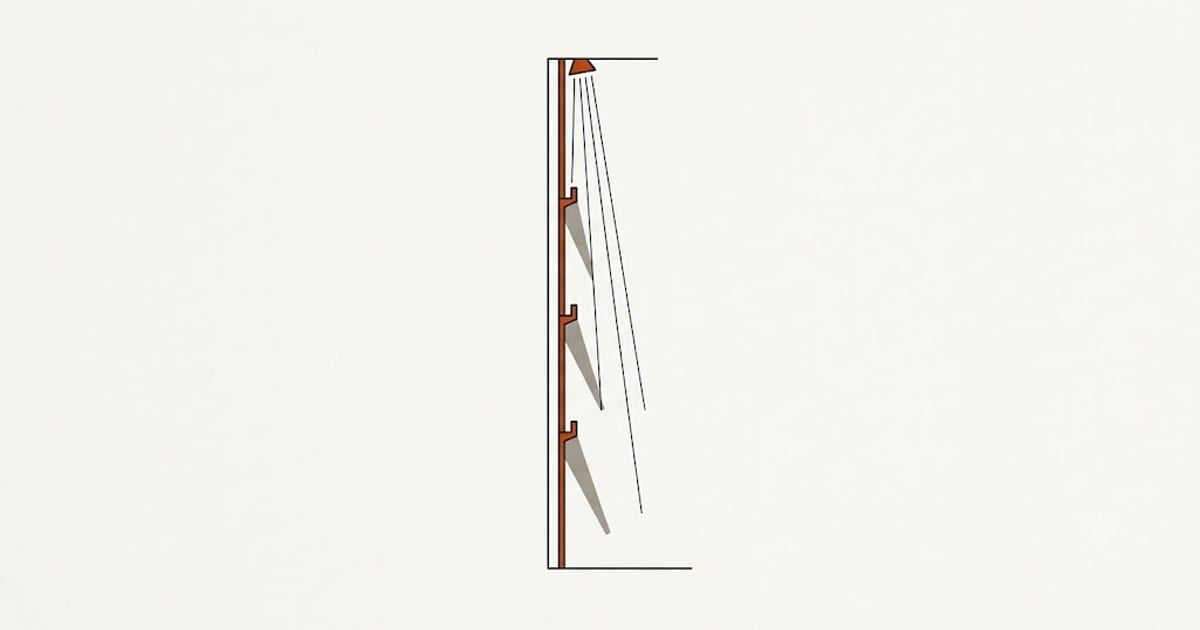
Raking light. Light travelling nearly parallel to the surface. Long hallways lit from one end. Walls beside a window, where afternoon sun runs down the wall. Stairwells with a skylight. Any wall with a wall-washer or a sconce close to it.
Sheen above eggshell. Satin, semi-gloss and gloss reflect specularly, so any difference in surface reflectance shows. The sheen decision and the finish decision are one decision, and it has to be made before the taper leaves.
Dark, saturated colours. Deep colours are usually applied over a tinted primer in fewer coats and show substrate variation more readily than off-white does.
Ceilings deserve a mention: a ceiling is lit from below at a raking angle by every lamp in the room. It is the most raking-lit surface in the house. Flat ceiling paint is what compensates for that on a level 4 ceiling, and it is why flat ceiling paint is near-universal.
The cost
| Rate | 12 × 16 room, 640 ft² | |
|---|---|---|
| Level 4 | $1.60–2.80 / ft² | $1,024–1,792 |
| Level 5 skim | +$0.40–1.00 / ft² | +$256–640 |
Plus one to two extra days for the skim to dry and be sanded.
On a whole house of 5,500 ft² of board, that is $2,200–5,500 — enough that it deserves to be specified room by room rather than as a blanket upgrade.
The substitute that works most of the time
A high-build primer, sometimes sold as a level 5 primer or a drywall surfacer. Sprayed and back-rolled, it lays down a thick film that fills and evens out surface porosity.
| Skim coat | High-build primer | |
|---|---|---|
| Cost | $0.40–1.00 / ft² | $0.12–0.25 / ft² |
| Extra days | 1–2 | 0 |
| Result under normal light | Excellent | Excellent |
| Result under raking light | Excellent | Good, not perfect |
| Under gloss | Excellent | Adequate |
On most jobs this is the right trade — a fraction of the price, no schedule impact, and a result nobody distinguishes without deliberately hunting for it.
It is worth asking for by name, because it is rarely offered. Painters quote a standard PVA primer by default and the upgrade costs very little.
Where it does not substitute: a genuinely raking-lit wall in gloss. There, skim.
Do not confuse level 5 with fixing a bad job
A skim coat over a poorly taped wall produces a smooth wall with the same lumps in it, because the skim follows the surface underneath. If the level 4 has proud joints, ridges or tool marks, those are level 4 defects and they should be fixed as level 4 defects — refused, and re-coated.
Specifying level 5 as insurance against poor workmanship is expensive and does not work.
Framing flatness is upstream of all of it
Neither finish fixes framing. A stud crowned 1/4 in proud of its neighbours shows under raking light through any finish level, and skimming over it just makes a smooth bulge.
It takes ten seconds to plane a crowned stud before boarding and considerable money afterwards, which puts it in the same category as the screw-pop problem — a framing issue that presents as a drywall complaint.
Deciding, quickly
Stand in the finished-framed room at the time of day the room gets its worst light, with a work light held flat against the wall and pointed along it. What you see then is what you will see forever.
Rooms that pass that test get level 4 and a good primer. Rooms that fail it get skimmed, and the cost of the room goes up by a quarter.