Plaster lost to drywall on schedule, not on quality. A plasterer needed weeks and a skilled hand; drywall needed a day of hanging and a week of drying, and most of that week the crew was elsewhere.
The performance comparison is still worth having, because the two systems genuinely differ.
The three systems
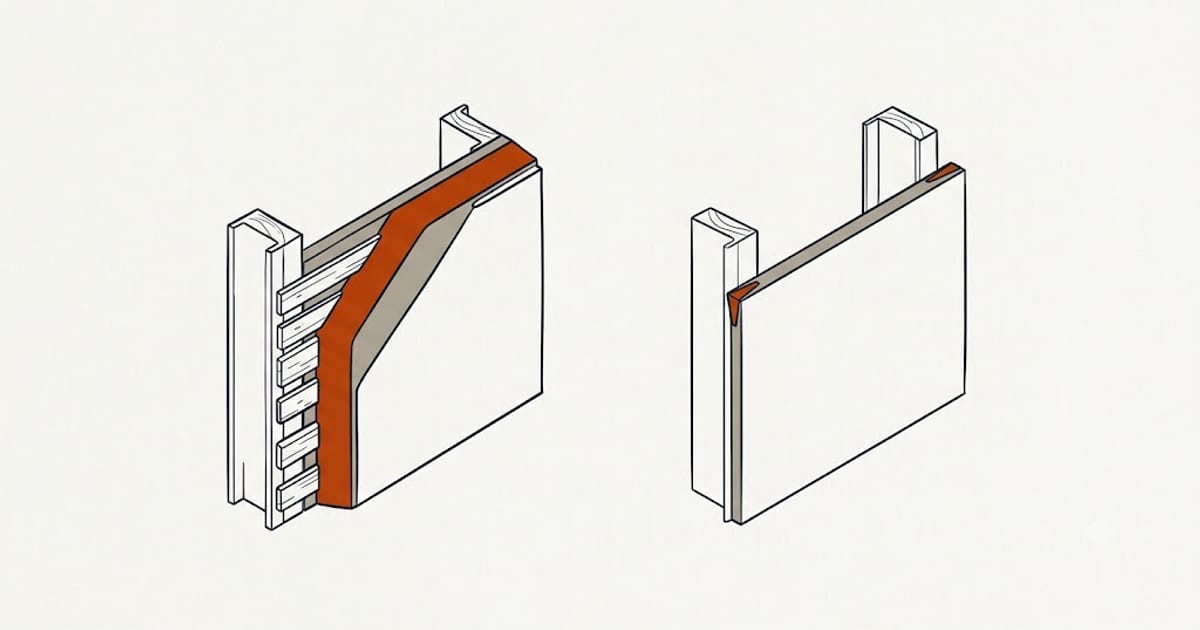
Traditional three-coat plaster. Scratch, brown and finish coats over wood or metal lath. 3/4 to 1 in thick. Essentially unavailable outside restoration work.
Veneer plaster. A 1/16 to 1/8 in coat of finish plaster over blueboard — a gypsum panel with a face designed to bond with plaster. Hangs like drywall, finishes like plaster, and is the practical modern option.
Drywall. Panels with taped joints and compound only at the joints and fasteners.
Cost per square foot, installed
| System | Materials | Labour | Total |
|---|---|---|---|
| Drywall, level 4 | $0.52 | $1.60–2.80 | $2.10–3.30 |
| Veneer plaster | $0.85 | $2.80–4.50 | $3.65–5.35 |
| Three-coat plaster | $1.40 | $7.00–14.00 | $8.40–15.40 |
Veneer plaster is roughly 1.5–1.8× drywall. Three-coat is 4–5×, and the labour figure is wide because the number of tradespeople who can still do it is small and their rates reflect that.
On a 12 × 16 room — 640 ft² of board — that is about $1,700 in drywall, $2,900 in veneer plaster, and $7,600 in three-coat.
Where plaster is genuinely better
Impact resistance. A plaster wall does not dent from furniture or a door handle. Drywall does, routinely.
Sound. A veneer plaster wall is measurably quieter — the higher density and monolithic surface add roughly 2–4 STC over drywall of similar thickness. Three-coat over lath adds more.
No joints, no photographing. Plaster is a continuous surface, so there are no taped joints to telegraph under raking light. That advantage is exactly what a level 5 drywall finish is buying by skimming the entire wall — which is to say a level 5 job is drywall imitating plaster, at a cost that closes much of the gap.
Curves. Plaster follows a curved or vaulted surface without kerfing, wetting or double-layering.
Speed of finish, oddly. Veneer plaster sets chemically and is finished the same day or the next. A drywall job with three coats is a week of drying. On a schedule-critical job that can matter more than the rate does.
Where drywall wins
Cost. Half or less.
Repairability. A drywall patch is a Saturday. A plaster patch needs matching material and a hand that can float a flat surface, and most drywall finishers will not attempt it.
Availability. Every builder can hang drywall. Veneer plasterers are regional, and in much of the country there are none.
Fire and moisture ratings. Type X and moisture-resistant products are engineered, tested and specified. Plaster assemblies have ratings too, but the paperwork is harder to produce for an inspector.
Existing plaster: repair or replace
The common real decision, in a house built before about 1955.
Repair when the plaster is largely sound and keying to the lath. Loose sections can be re-secured with plaster washers and screws for a few dollars a square foot, and cracks filled with setting-type compound and tape. This preserves the acoustic and impact performance, and it is far cheaper.
Skim-coat over when the plaster is sound but the surface is poor. A veneer or a compound skim over stable plaster runs $1.50–3.00 per square foot and gives a new surface without demolition.
Replace when large areas have lost their keys and are drumming hollow, or when the walls are coming apart for wiring and insulation anyway. Once walls are open, drywall is the obvious refill.
Overboard when the plaster is bad and the trim is good. 3/8 in drywall screwed through the plaster into the studs adds only 3/8 in of depth, keeps the plaster's mass, and avoids the demolition entirely. Screws must reach the studs — the plaster is not a fastening substrate — and that means longer screws than usual and finding every stud.
The dust argument
Plaster demolition is one of the dirtiest operations in residential work, and pre-1980 plaster may contain asbestos in the base coats and lead in the paint. Testing costs $30–80 and it belongs before any decision, not after the first wall comes down.
That single line has ended more replace-it plans than the cost comparison ever has.